Reprinted from The Glenite [newsletter of the Residents of Beverly Glen], Spring 2024, p. 6
One of the delights of the Glen is the abundance of Coast Live Oak trees. They are part of the indigenous vegetation that would have been found along the canyon bottom, which this winter has forcefully reminded us is a stream, and up the moister slopes around it. And where you have enough oaks together, you’re likely to spot the Oak Titmouse (Baeolophus inornatus). Both sexes of this jaunty little bird sport raised crowns, and they have quite a bit of attitude, so I think of them as king and queen of the oak trees.
These titmice aren’t exactly flashy. They’re mostly shades of gray, so much so that their species name (inornatus) literally means “undecorated,” and they used to be known by the name “Plain Titmouse.” But don’t let that fool you; they have plenty of personality. They chatter to each other and will let you know if you are in their territory.
Oak Titmice mate for life and are territorial so except when they are raising young, the titmice that you see in one place from day to day will be the same individual birds. The oldest recorded Oak Titmouse in California was nine years old, so this is true year to year as well.
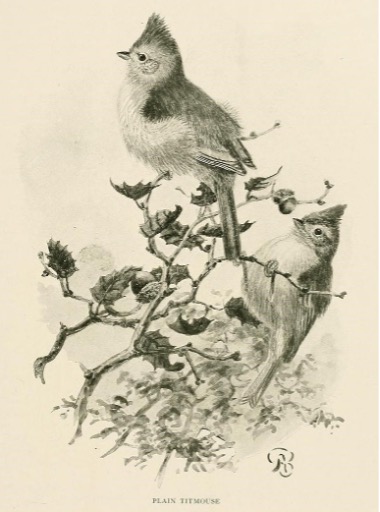
Oak Titmice eat both insects and seeds. They glean insects from the oak foliage almost constantly. Native oak trees are necessary because it is only our native trees that have enough insects on them. The birds keep the insects in balance to the benefit of the trees. Both are part of a healthy ecosystem.
They typically roost in cavities in trees or in dense foliage that feels like a cavity. They also nest in cavities or will use nest boxes designed for smaller birds. We have such a box on our house under a large oak. The spring is marked by the titmice spending more time around the box, then becoming scarcer for two weeks during incubation. Soon, however, both the male and female are making nearly constant trips to the box to feed their young. They can lay three to nine eggs and we’ve typically seen four or five fledglings. The nestlings at first can barely be heard as faint high-pitched squeaking during each food delivery but then louder and lower squeaks as they grow and finally fledge. To stand near the nest box and hear the begging of the nestlings each time a parent arrives with food is a treat.
The young stick around for a while until they are pushed out of the territory by their parents. Then they must find a mate and a territory, usually by their first fall, or live in marginal habitat until they do.

Oak Titmice can be found from southern Oregon through the oak woodlands of California, both in the coastal ranges and the foothills of the Sierra Nevada, and south through San Diego County into Baja. They are, unfortunately, in decline throughout most of this range, according to published analysis by Cornell Lab of Ornithology of observations submitted by birders to their eBird website. For the area including Beverly Glen, numbers were down 23% from 2011 through 2021.
We can do our part to protect these companions of the canyon by protecting native oak trees and planting more where they will thrive. If you have oaks very close by, a nest box with a 1.25-inch diameter opening, and interior dimensions of 4 inches on a side and 9 inches tall is ideal. Install at least five feet off the ground and avoid having any branches that could allow squirrels or other animals to access the opening. Enjoy the king and queen of the oaks!
May 17, 2024
Featured image: By Alan Vernon – Oak Titmouse (Baeolophus inornatus), CC BY 2.0
 Travis Longcore
Love this
<
div dir=”ltr”>
diana nicole ecological horticulture
<
blockquote type=”cite”>
LikeLike