Two councilmembers in the City of Los Angeles recently put forward a resolution that would request that California law be amended so that the Mountains Recreation and Conservation Authority, a local joint powers agencies that owns land in and adjacent to the City of LA, be required to “clear brush” on their lands to 700 feet from all structures. Current City of Los Angeles regulations require vegetation management within 200 feet of structures, and State regulations require 100 feet of defensible space.
The purpose of defensible space is to reduce the intensity of wildland fires as they approach structures, spacing vegetation so that fire spread is more difficult, and allowing firefighters a safe zone within which to defend the structure. Hence, the term “defensible space.” Some may think that if some defensible space is good, then more must be better. This is not the case. Scientists have studied defensible space and concluded that 100 feet is the most that is needed. And in chaparral environments like that in Los Angeles, more vegetation removal than that simply results in the replacement of the evergreen chaparral plants with annual grasses (as also happens with too frequent fires in chaparral; Keeley et al. 2005). Those annual grasses ignite more easily and burn faster than the native vegetation, so it is very important that defensible space be sufficient but not excessive to be as effective as it can be.
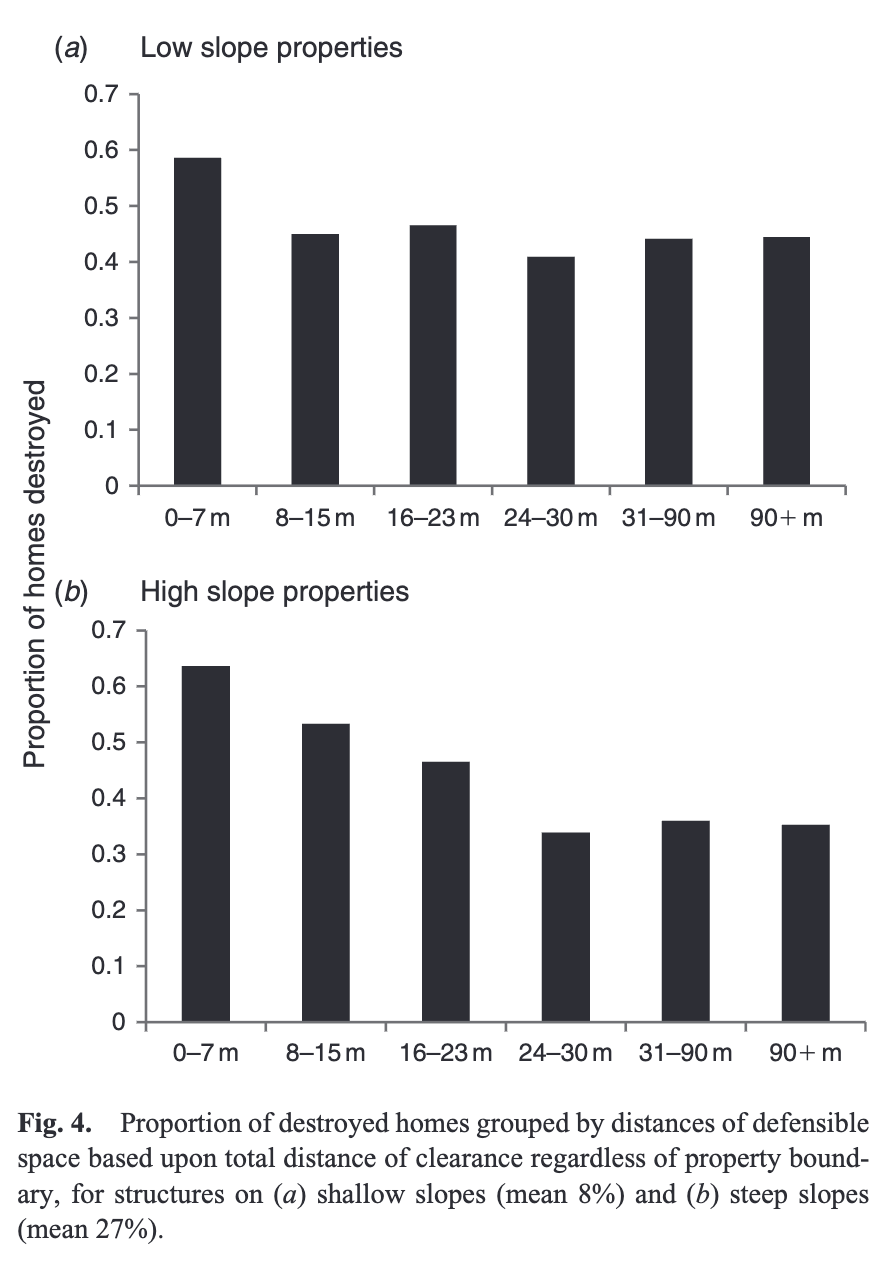
To evaluate the right amount of defensible space, scientists look at structure survival during actual fires and separate out the influence of different factors, such as landscape position, topography, and distance between structures, as well as different amounts of defensible space present before the fire. In a study involving 2,000 structures in San Diego County, researchers found that the most effective defensible space distance varied from 16-58 feet, with no further benefit beyond 100 ft. Even on steep slopes, no benefit came from clearance beyond 100 ft (30 m; Syphard et al. 2014). This result is visible in the raw data showing proportion of homes destroyed with different categories of defensible space (right), indicating increased distance of defensible spacing being beneficial for high slope properties.
Defensible space does not mean complete vegetation removal. It is composed of two elements, the distance within which vegetation is managed, and the percent vegetation removed within that area. The San Diego study provides insight on the amount of vegetation removal necessary.
[A]s with defensible space, percentage clearance did not need to be draconian to be effective. Even on steep slopes, the effective percentage clearance needed on the property was <40%, with no significant advantage beyond that.
Syphard et al. 2014
In this comprehensive study in a similar habitat to Los Angeles, it is plain to see that there is no benefit to clearing more than 100 ft from structures and that within that zone, 60% of the vegetation cover can remain while still realizing the benefits of defensible space. No one should expect defensible space to eliminate structure loss in a wind-driven wildland fire — in those conditions, both home hardening and defensible space influence only 14% of the variation in whether a building burns, with other factors such as slope, aspect, and housing density being far more important (Syphard et al. 2017).
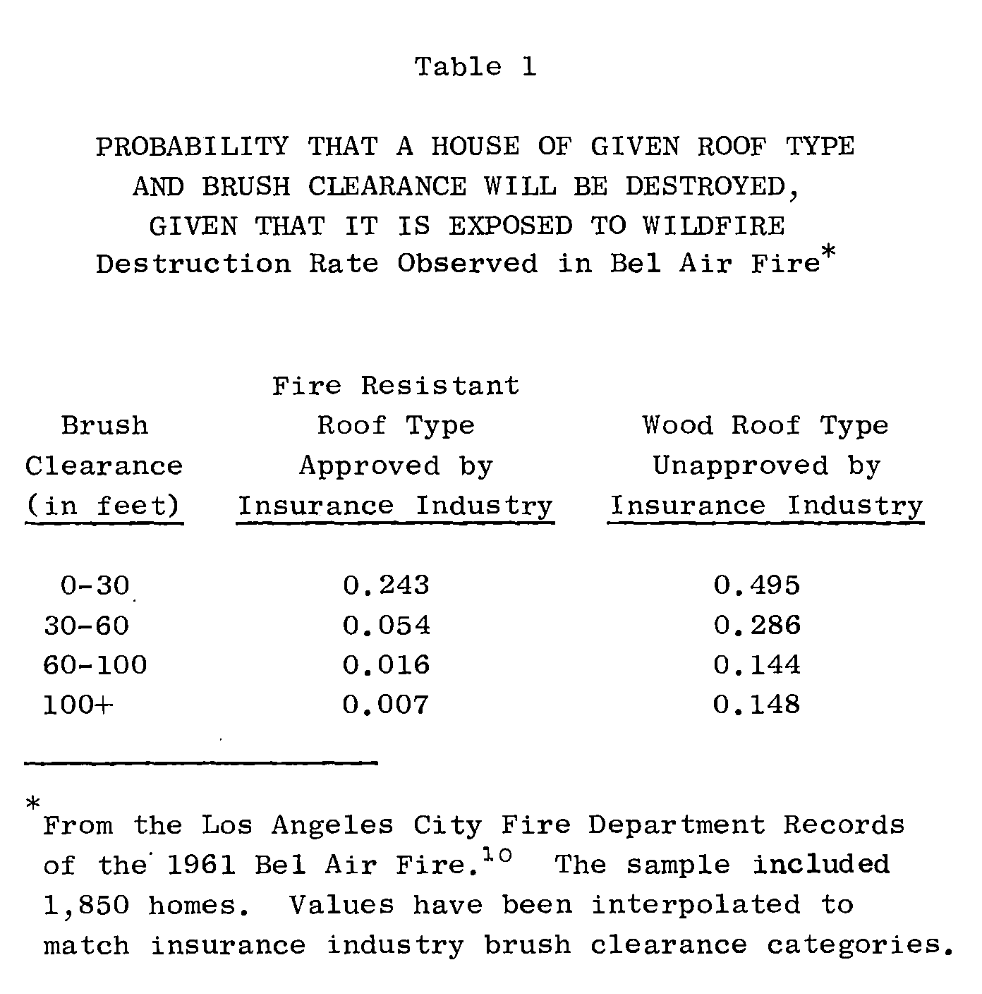
Scientists have known for decades that 100 ft of vegetation management is sufficient. Following the 1961 Bel Air Fire, an assessment of roof type and vegetation clearance found that for buildings without fire-resistant roofs, clearance was only useful to 60 ft, and for buildings with fire-resistant roofs, 100 ft of clearance further reduced risk of loss. For buildings with fire-resistant roofs and 100 ft of clearance, the loss percentage was less than 1% (Howard 1973).
Defensible space may play little role in structure survival for intense, wind-driven fires in chaparral — exactly the kind of fire most like to threaten homes in Los Angeles. Researchers investigating the 2018 Woolsey Fire in the Santa Monica Mountains found that building materials and landscape factors were of far greater importance than vegetation.
Despite detailed pre-fire information on vegetation around nearly 11,000 buildings, we did not find a critical role for vegetation in defensible space in relation to building outcomes after the Woolsey Fire.
Mockrin et al. 2023
The reason for this is that during wind-driven fires, most of structure ignition comes from embers and firebrands that make their way into structures through vents and eaves, burning the structure from the inside out. Of course firebrands can ignite fences and other highly flammable features adjacent to structures as well. But once vegetation has been managed to allow safe firefighter access within 100 feet of structures and vegetation cover reduced by 40%, the role of defensible space in terms of stopping the direct movement of fire to a structure is done, and further outward clearance is not necessary. To fight firebrands and embers, building materials and design characteristics are critically important (Syphard et al. 2017; Mockrin et al. 2023).
Why would anyone request 700 feet of clearance? When I was researching the effects of fuel modification on wildlife in the early 2000s (Longcore 2003), I interviewed many fire officials and insurance industry representatives to try to sort out the origin of the City of Los Angeles rule for 200 feet of defensible space, or its adoption by the California FAIR plan. No one I talked to could point to a written report or underlying rationale for 200 feet and the best guess of anyone I spoke with was that it came from a fire inspector who “wanted to make Captain.” In the subsequent years, the scientific literature has not provided any support for more than 100 feet of defensible space as far as I can find, while the damaging environmental impacts of excessive clearance have only become clearer. The proposal for 700 feet seems to be a reflexive action in response to the devastating January 2025 fires in Los Angeles, but this action would increase fire risk rather than decreasing it. That much clearance would damage wildlife habitat while increasing fine fuels that will burn quickly and ignite more easily, thereby raising the likelihood of more frequent fires, while wind-driven firebrands will still reach homes. It is a lose-lose-lose proposition.
Travis Longcore, Ph.D.
April 20, 2025
Literature Cited
Howard, R. A., D. W. North, F. L. Offensend, and C. N. Smart. 1973. Decision analysis of fire protection strategy for the Santa Monica mountains: an initial assessment. Stanford Research Institute, Menlo Park, CA.
Keeley, J. E., M. Baer-Keeley, and C. Fotheringham. 2005. Alien plant dynamics following fire in Mediterranean‐climate California shrublands. Ecological Applications 15:2109–2125.
Longcore, T. 2003. Ecological effects of fuel modification on arthropods and other wildlife in an urbanizing wildland. Pages 111–117 in K. E. M. Galley, R. C. Klinger, and N. G. Suguihara, editors. Proceedings of Fire Conference 2000: The First National Congress on Fire Ecology, Prevention and Management. Tall Timbers Research Station, Tallahassee, Florida.
Mockrin, M. H., D. H. Locke, A. D. Syphard, and J. O’Neil-Dunne. 2023. Using high-resolution land cover data to assess structure loss in the 2018 Woolsey Fire in Southern California. Journal of Environmental Management 347:118960.
Syphard, A. D., T. J. Brennan, and J. E. Keeley. 2014. The role of defensible space for residential structure protection during wildfires. International Journal of Wildland Fire 23:1165–1175.
Syphard, A. D., T. J. Brennan, and J. E. Keeley. 2017. The importance of building construction materials relative to other factors affecting structure survival during wildfire. International Journal of Disaster Risk Reduction 21:140–147.
 Travis Longcore